
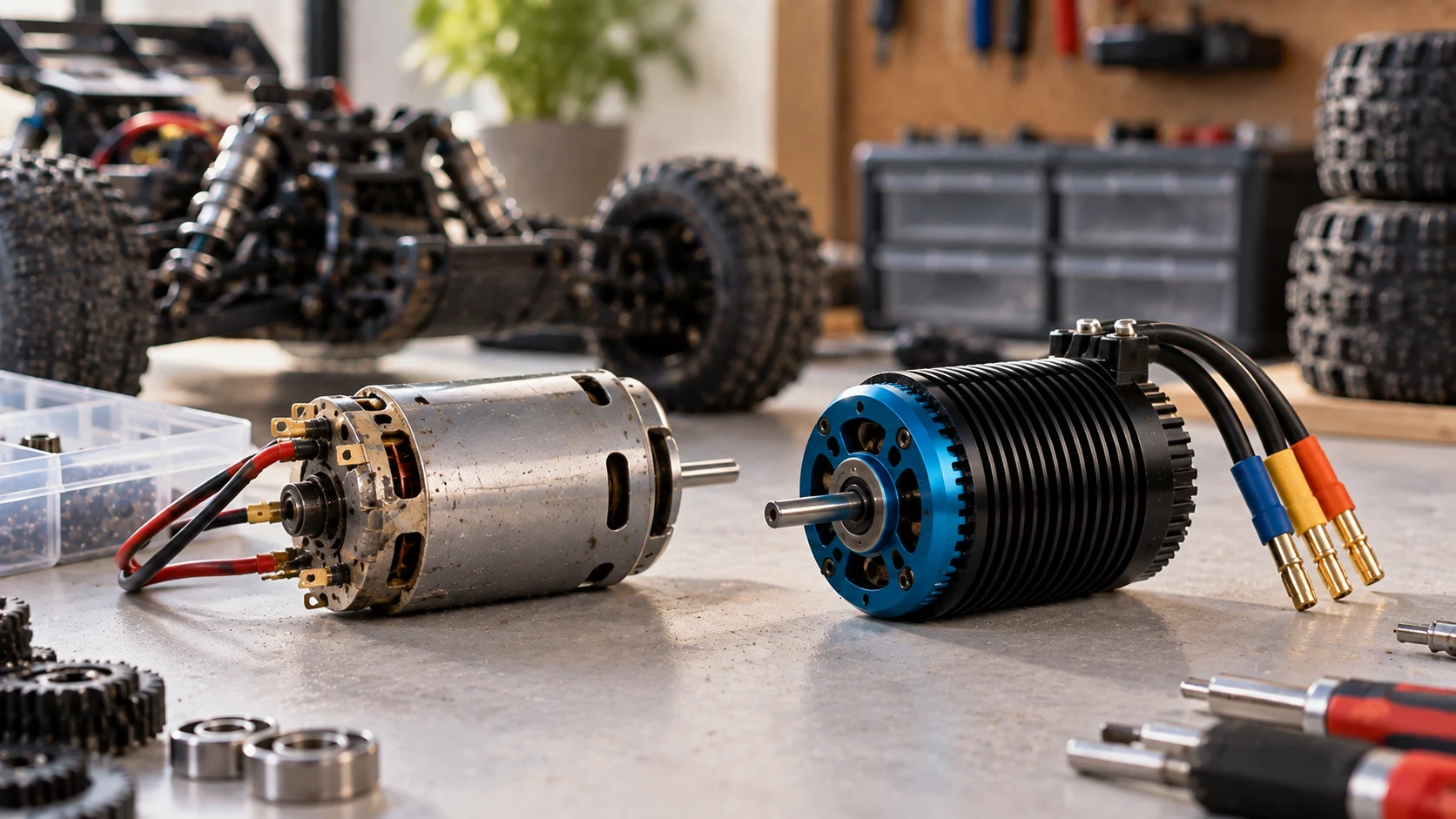
Ask any experienced RC racer what the highest-impact upgrade they ever made was, and “brushless conversion” comes up more than almost anything else. If you’re comparing RC cars or weighing your first motor upgrade, “brushed vs brushless” is the decision that shapes nearly everything downstream — price, speed, maintenance, and even which battery you’ll need. Here’s a full, practical breakdown, with an eye on what actually holds up in Gulf heat and dust.
How they’re different, in plain terms
A brushed motor uses physical carbon brushes that make contact with a spinning commutator to generate motion — simple, reliable, and inexpensive, but that physical contact creates friction, heat, and gradual wear over time. A brushless motor uses electronic commutation instead of physical brushes, so there’s no contact wear, less heat generated, higher efficiency, and significantly more power for the same size and weight of motor.
Performance: no real contest
Brushless motors deliver noticeably more speed and torque than a brushed motor of comparable size, run cooler under sustained load, and don’t lose performance as they wear in over time — brushed motors gradually lose efficiency as their brushes and commutator wear down. If raw speed and acceleration are the goal, brushless wins outright, which is why nearly every serious racing setup across Qatar and the wider GCC runs brushless.
Cost and simplicity: brushed wins
Brushed systems cost less upfront — both the motor itself and the compatible ESC — and are simpler to understand for a first-time buyer. Many entry-level RTR cars ship brushed for exactly this reason: it’s a forgiving, affordable way to learn car setup and driving before investing further in the hobby.
Maintenance: brushless is nearly maintenance-free
Brushed motors need occasional brush replacement and commutator cleaning as they wear — a normal part of ownership, not a defect, but still a recurring task. Brushless motors are essentially sealed with no wearing contact parts, which matters even more in dusty Gulf conditions, where fewer moving parts means less that sand can damage or wear prematurely.
Heat and efficiency — why it matters more here
Because brushless motors don’t lose energy to brush friction, they run cooler and convert more of your battery’s energy into actual motion rather than heat. This matters in the Gulf specifically: a cooler-running motor is both more efficient and more reliable when ambient temperatures are already pushing your car’s electronics toward their limits, whether you’re driving in Doha, Abu Dhabi, or Riyadh in peak summer.
kV rating: matching motor to use case
When shopping brushless, you’ll see a kV rating on the motor (such as 3300kV or 1650kV). Lower kV motors deliver more torque at lower speed — better suited for rock crawling and technical, low-speed driving. Higher kV motors spin faster and suit speed-focused racing and bashing. Always match kV to your ESC’s rated voltage and your car’s gearing; an unmatched combination risks overheating both the motor and the ESC — a mistake that shows up faster in hot climates than cool ones.
Do you need a new ESC too?
In almost every case, yes. Brushed and brushless motors use fundamentally different ESCs, so upgrading to brushless usually means replacing your ESC as a matched pair, not swapping the motor alone. Buying a mismatched motor/ESC combination is one of the most common (and expensive) upgrade mistakes — always check compatibility, or ask our team to confirm a pairing before you buy.
Hobby World Team Tip
If you’re upgrading to brushless specifically because your current brushed setup keeps overheating on hot days, don’t stop at the motor. A brushless ESC still needs airflow, and in Gulf heat, a poorly ventilated chassis will bottleneck your new motor’s benefits. Pair the upgrade with a quick check of your car’s ESC placement and cooling — it’s a five-minute check that protects a much more expensive part.
Our recommendation
New to RC and building your first car on a budget? Start brushed — it’s an honest, low-risk way to learn car setup and driving fundamentals. Already comfortable with the basics and chasing more speed, or tired of your current setup struggling with local heat? A brushless upgrade is one of the highest-impact changes you can make to an existing car. HobbyWing and Maclan both stock strong, well-supported brushless motor and ESC combinations, with parts readily available locally across Qatar and the region.
Is brushless faster than brushed for RC cars?
Yes — brushless motors deliver more speed and torque than a comparably sized brushed motor, and maintain that performance as they age, unlike brushed motors which wear down over time.
Can I put a brushless motor in a brushed RC car?
Usually not without also replacing the ESC — brushed and brushless motors require different, incompatible ESC types. Budget for both as a matched upgrade.
What does kV mean on a brushless motor?
kV indicates how many RPM the motor produces per volt with no load. Lower kV means more torque at lower speed (good for crawling); higher kV means more top speed (good for racing/bashing).
Is brushless worth it for a beginner?
Not usually as a first motor — brushed is cheaper and more forgiving while you’re still learning car setup. Brushless is a strong second step once you understand the basics.
Do brushless motors handle Gulf heat better than brushed motors?
Generally yes — brushless motors run cooler and more efficiently under load, which helps in high ambient temperatures, though airflow and ESC placement still matter.

Add comment