How to Choose the Right RC Battery (NiMH vs LiPo, Voltage & mAh Explained)
Every experienced RC racer has a battery story — a pack that puffed up in a hot car, a charger left unattended a little too long, a race lost to voltage sag at the worst possible moment. Battery specs look like a foreign language at first — 2S, 3S, 50C, 5000mAh — but none of it is guesswork once you know what each number actually controls. This guide breaks it down so you buy the right battery the first time, and handle it safely in a climate that’s genuinely tougher on batteries than most of the world.
That last point matters more here than the spec sheets usually let on. Whether you’re driving in Doha, Dubai, Riyadh, Kuwait City, Manama, or Muscat, Gulf summer heat changes how batteries should be stored and charged — not just how they perform on the track.
NiMH vs LiPo: the real difference
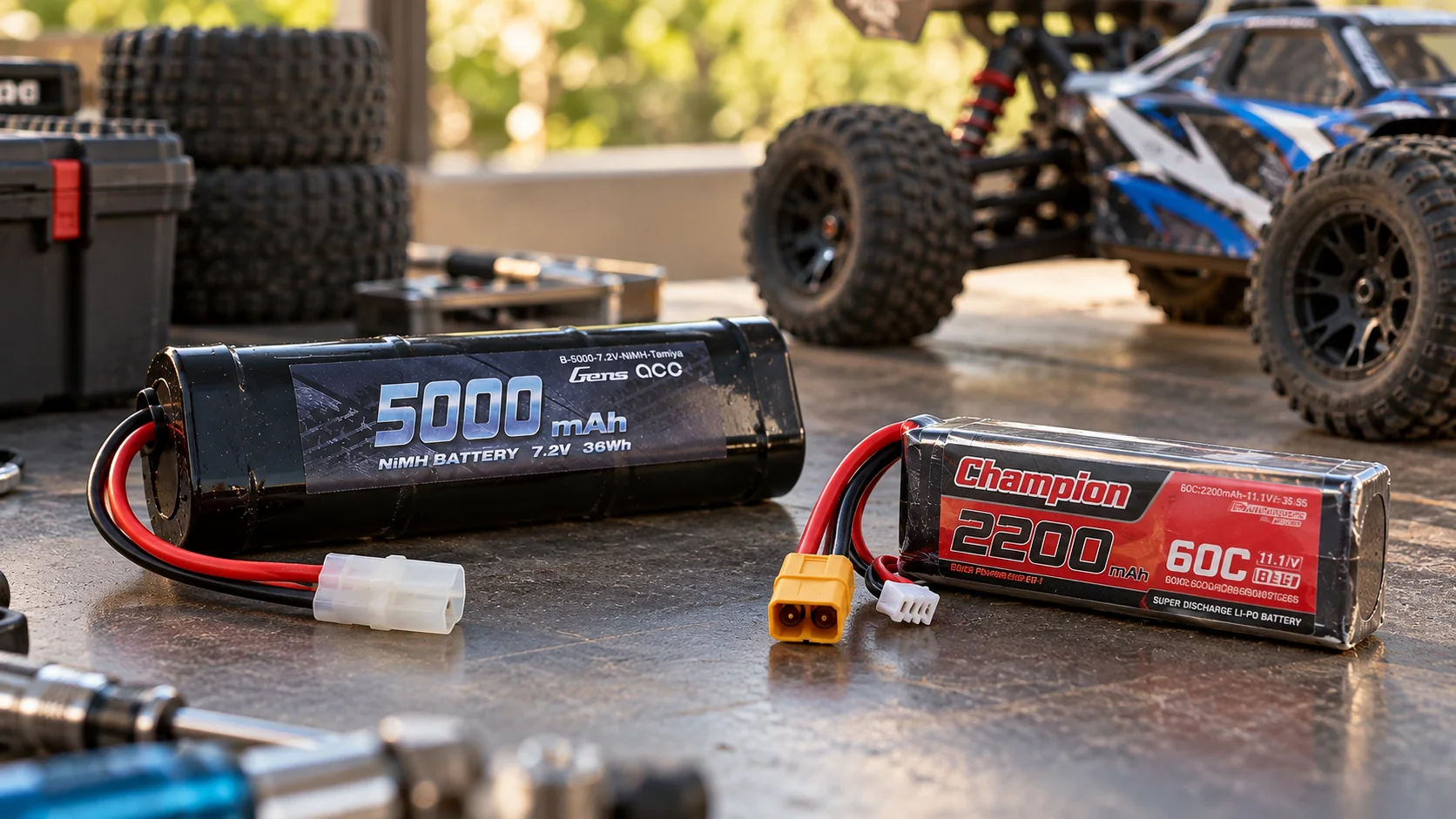
NiMH (Nickel-Metal Hydride) batteries are heavier and hold less energy per gram, but they’re tough, inexpensive, and nearly impossible to damage through normal use — a solid choice for beginners and casual bashing. LiPo (Lithium Polymer) batteries are lighter and pack far more power, giving noticeably faster acceleration and longer runtime, but they demand a dedicated LiPo charger, a fire-safe charging bag, and real attention to storage voltage — more so in a hot climate than a temperate one. If you’re chasing performance, LiPo is worth the extra care; if you want simplicity and durability, start with NiMH.
| Feature | NiMH | LiPo |
|---|---|---|
| Weight | Heavier | Lighter |
| Power density | Lower | Higher |
| Cost | Lower | Higher |
| Charging care needed | Minimal | Significant, especially in Gulf heat |
| Best for | Beginners, casual bashing | Performance, racing |
Voltage and “S” rating explained
You’ll see LiPo batteries labeled 2S, 3S, 4S and so on. Each “S” represents one 3.7V cell wired in series — so a 2S battery is 7.4V, a 3S is 11.1V, and a 4S is 14.8V. More cells means more voltage, which means more power and speed, but also more stress on your motor and ESC. Always match battery voltage to what your car’s electronics are rated for — check your manual, or ask our team to confirm before you upgrade voltage.
mAh: how long you’ll actually drive
mAh (milliamp-hours) measures capacity — how much energy the battery stores, and roughly how long a charge will last under similar driving conditions. A 5000mAh battery will run notably longer than a 3000mAh battery at the same voltage and discharge rate. More mAh usually also means a physically larger, heavier battery, so always check it fits your car’s battery tray and doesn’t throw off its weight balance.
C-rating: how fast the battery can deliver power
The C-rating tells you the maximum safe continuous discharge rate. A higher C-rating (50C vs 25C, for example) can deliver power faster, which matters for high-performance motors that draw heavy current under acceleration. For casual driving, a mid-range C-rating is plenty; racers running brushless power systems should look for a higher-rated pack to avoid voltage sag under load — that sag is usually what a driver actually feels as “the car went soft” mid-race.
How to read a full battery label
A label reading “3S 5200mAh 50C” tells you: 11.1V (3S), 5200mAh capacity, and a 50C maximum safe discharge rate. Once you can read one label, you can read them all — the same three numbers appear on every LiPo pack regardless of brand.
Hobby World Team Tip
Heat is the variable most guides skip, and it’s the one that matters most here. A LiPo battery left in a parked car in a Gulf summer can sit well above its safe charging temperature within minutes — charging it in that state is a genuine fire risk, not a theoretical one. Our rule of thumb: if the battery feels warm to the touch from ambient heat (not from driving), let it cool to room temperature indoors before it goes anywhere near a charger. It costs you twenty minutes. A damaged pack costs you far more.
Charging and storage safety in Qatar and across the Gulf
Always use a charger designed for your battery’s chemistry, never leave a charging LiPo unattended, and store LiPo batteries at storage voltage (around 3.8V per cell) if you won’t use them for more than a few days. Keep batteries out of direct sunlight and out of hot parked cars year-round, not just in peak summer — ambient temperatures across the region climb fast even in shoulder seasons. We cover this in more depth in our Heat & Sand maintenance guide.
Matching a battery to your car type
- Casual bashing/beginners: NiMH or a 2S LiPo, mid-range C-rating — durability over raw power.
- Racing: Higher-C 2S–3S LiPo matched exactly to your ESC’s rated voltage.
- Rock crawling: Lower C-rating is fine — crawling draws current steadily, not in bursts, so capacity (mAh) matters more than C-rating.
Is LiPo or NiMH better for a beginner?
NiMH is generally better for beginners — it’s more forgiving, cheaper, and doesn’t require special storage voltage or a dedicated charger.
What does 3S mean on an RC battery?
3S means three 3.7V cells wired in series, giving a total voltage of 11.1V. More “S” means more voltage and more power.
What C-rating do I need for my RC car?
Casual driving is fine with a mid-range C-rating (25–35C). High-performance brushless setups benefit from 50C or higher to avoid voltage sag under hard acceleration.
Can I charge a LiPo battery with a NiMH charger?
No — always use a charger designed specifically for your battery’s chemistry. Using the wrong charger is a serious fire and safety risk.
Is it safe to store RC batteries in a hot car in Qatar or the GCC?
No. Heat degrades LiPo cells and raises fire risk. Store batteries indoors, out of direct sunlight, and let them cool before charging if exposed to heat.