
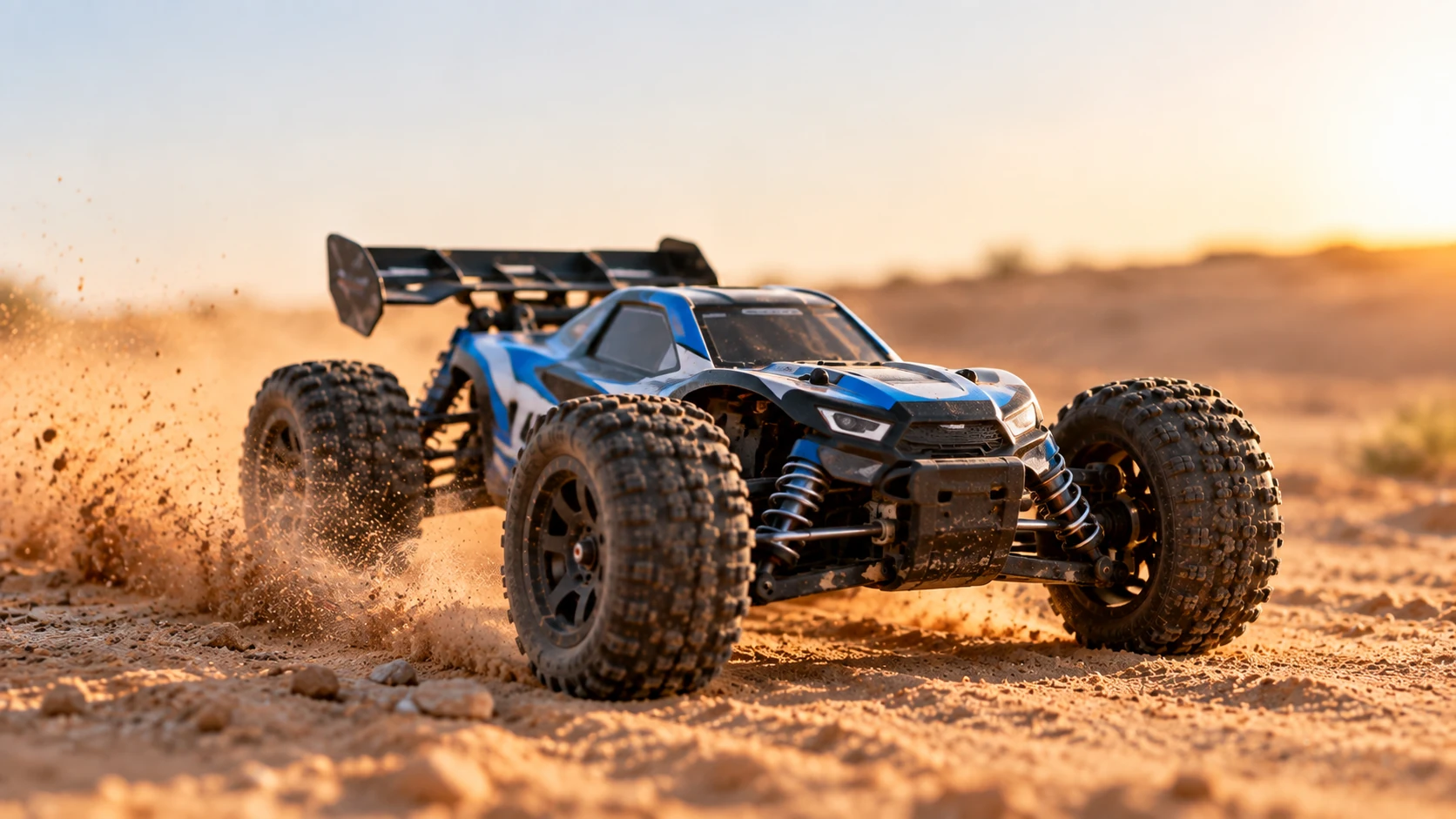
Ask five RC hobbyists what to buy first and you’ll get five different answers — scale, brand, drivetrain, all up for debate. What most agree on, after years of watching newcomers make the same mistakes, is that the type of car matters far more than the badge on it. This guide is built around that experience, with a particular eye on what actually holds up in Qatar and the wider Gulf: heat, sand, and long driving seasons that most manufacturer manuals never mention.
RC enthusiasts across Qatar, the UAE, Saudi Arabia, Kuwait, Bahrain, and Oman deal with a fairly similar set of conditions — hot summers, fine windblown sand, and a mix of paved compounds and open desert edges for driving. A car that’s a great beginner pick in a cooler, wetter climate isn’t automatically the right pick here, and that’s the gap this guide tries to close.
Start with an RTR car, no exceptions
An RTR (Ready-to-Run) car arrives assembled, tuned, and ready to drive — no soldering, no gearing calculations, no calibration guesswork. Kit-built cars are genuinely rewarding once you understand what you’re adjusting and why, but as a first purchase in the Gulf’s heat and dust, they mostly add cost and troubleshooting time without adding fun. Every recommendation below assumes RTR.
Scale: why 1/10 is the sensible starting point
Scale (1/8, 1/10, 1/12) describes size relative to a real car. For most beginners in Qatar and across the GCC, 1/10 scale hits the sweet spot: agile enough for tight compounds and parking areas, tough enough for the region’s mix of pavement, packed sand, and gravel, and backed by the widest range of affordable, easy-to-source spare parts. 1/8 scale cars are faster and more capable off-road, but they cost more to buy, run, and repair — a natural second car once you know what kind of driving you enjoy, not a first one.
Bashing, racing, or crawling — pick your style before your brand
This is the single most common regret we hear from first-time buyers: choosing the wrong type of car for how they actually planned to drive it.
- Bashers (ARRMA is the benchmark here) are built to absorb hits, jumps, and rough terrain — the right choice for casual driving on compound roads and open sandy ground.
- Race cars prioritize speed and handling on a smooth, prepared surface, and are less forgiving of rough ground or loose sand.
- Rock crawlers (AXIAL leads this category) are built for slow, technical climbing over obstacles rather than speed — a different kind of satisfaction, popular with drivers who enjoy the technical puzzle over raw pace.
If you’re not sure yet, a basher is the most versatile first choice for regional conditions — it tolerates being driven somewhere it “shouldn’t” be far better than a race car does.
Brushed vs brushless, the short version
Most beginner RTR cars ship brushed, and that’s a feature, not a shortfall. Brushed motors are simpler, cheaper, and more forgiving while you’re still learning throttle control. Brushless motors deliver more speed and power but reward a driver who already has some stick-time in. Start brushed; move to a brushless motor and matching ESC once you’ve genuinely outgrown your first car’s performance (our full brushed vs brushless comparison covers the technical trade-offs).
Battery basics for your first car
Most beginner RTR cars ship with either NiMH or a low-cell-count LiPo battery. NiMH is the more forgiving option — hard to damage, no special storage-voltage discipline required — which makes it a sensible first battery even though LiPo delivers more power per gram. If your car ships LiPo-ready, learn safe charging and storage practice before your first drive (see our full RC battery guide). Either way, budget for a second battery early: nothing ends a good session faster than one flat pack with no backup.
Hobby World Team Tip
Here’s something that doesn’t show up in most buying guides: in Gulf heat, tire compound matters almost as much as motor choice. Softer, warm-weather tire compounds that grip well in temperate climates can go greasy and slick on hot asphalt here by midday. If you’re driving mostly on paved compound roads through summer, ask about a harder or region-appropriate tire compound when you buy — it’s a cheap swap that saves you from chasing a “handling problem” that’s actually just a tire problem. And whatever car you choose, keep a spare tire set on hand from day one — it’s the single most-replaced part in a beginner’s first few months, in Doha as much as in Dubai or Riyadh.
What Gulf conditions mean for your first car
Fine desert sand and sustained summer heat are harder on RC electronics than most manufacturer manuals account for, whether you’re driving in Qatar, the UAE, or Saudi Arabia. Look for a car with reasonably sealed electronics and an easy-access gearbox, and build in a quick post-drive clean after any sandy session — sand in bearings and motor vents is the number one cause of early wear across the region. We cover a full maintenance routine for local conditions in our Heat & Sand guide.
What to budget for beyond the car itself
Your first RC car is rarely your only purchase. A realistic starter budget includes:
| Item | Why you need it |
|---|---|
| Spare battery | So one dead battery doesn’t end your session. |
| Basic tool kit | Wheel nuts, body clips, and screws loosen with use. |
| Spare tire set | The first part most beginners wear out or break. |
| Body clips/pins | Easy to lose, cheap to replace. |
| Replacement bearings | Sand exposure shortens bearing life faster than most buyers expect. |
Our beginner picks
Hobby World stocks RTR models from ARRMA, AXIAL, and Tamiya — all three are forgiving to drive, easy to find local spare parts for, and backed by a wide upgrade path as your skills grow. Browse the full RTR RC Cars category filtered to Ready-to-Run models, or message our team on WhatsApp with your budget and where you’ll be driving — compound roads, open desert edge, or both — and we’ll recommend a specific model and tire setup to match.
What is the best beginner RC car scale?
1/10 scale is generally the best starting point across Qatar and the GCC — agile, durable, and supported by the widest range of affordable spare parts.
Should a beginner buy a brushed or brushless RC car?
Start with brushed. It’s cheaper, more forgiving to learn on, and lets you build driving skill before investing in brushless performance.
Do I need a spare battery for my first RC car?
Yes — a second battery is the single most useful accessory, letting you keep driving while one battery charges.
Is an RTR or a kit-built car better for a first RC car?
RTR (Ready-to-Run) is strongly recommended for beginners — it arrives fully assembled and tuned, with no technical setup required.
Do RC cars need different tires for Gulf heat and sand?
Often, yes. Softer tire compounds can go slick on hot pavement, and open sand favors different tread than a compound road does — ask about a regionally suited tire when you buy.

Add comment